
Representation of Galungan Culture in Character Illustration: An Analysis of Form and Color
DOI:
https://doi.org/10.55732/c3q6ck50Keywords:
Galungan, Representation, Psychological, Illustration, CharacterAbstract
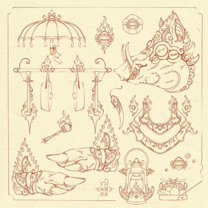
Hari Raya Galungan, a Hindu ceremony celebrated every six months (210 days), symbolizes the victory of Dharma over Adharma. Although it has long been immortalized in Balinese art and culture, the visual representation of its characters in illustration remains limited. One illustrator, Anak Agung Gede Alit Citra Bayu, represents the mythological and religious characters of Galungan through illustration. Research on the representation of Galungan's religious and cultural values in modern illustration is still scarce. This study aims to analyze the characters in the "Galungan" illustration series published on the Instagram account @gungdekarart, with a focus on form and color. Instagram was selected as the research medium because it is the primary platform where the illustrator actively publishes and distributes the "Galungan" works to a wide audience, making it a representative and accessible source of visual data for analysis. This study employs a qualitative method with a visual analysis approach based on Rudolf Arnheim's theory of visual elements, which emphasizes principles of visual perception such as form and color to interpret the meaning behind the distortion and deformation of traditional forms in the artworks. Primary data were obtained through observation of the three illustrations series and an interview with Anak Agung Gede Alit Citra Bayu as the illustrator, while secondary data were obtained from books, journals, and other literature related to Balinese iconography and visual design theory. The results show that the three "Galungan" illustration series display the distortion and deformation of traditional Balinese forms into imaginative forms, each with distinct characteristics: Series 1 emphasizes the objects used in the Penyajaan Galungan (offering preparation), Series 2 focuses on Penampahan Galungan (the day of ritual slaughter/preparation), and Series 3 depicts the peak of the Galungan celebration itself. All three series consistently adopt an aged-paper color (sepia/brownish) as the latar belakang, combined with contrasting-colored garis luars to evoke a classic impression while emphasizing the characters' silhouettes. This research contributes to the field of Visual Communication Design (VCD), particularly in documenting and analyzing strategies for visualizing Balinese religious culture into contemporary illustration forms, as well as providing an academic reference for illustrators and scholars in developing visual characters rooted in local wisdom.
Downloads
Published
Issue
Section
License
Copyright (c) 2026 Journal of Computer Science and Visual Communication Design

This work is licensed under a Creative Commons Attribution-ShareAlike 4.0 International License.


